Decide What You Want
Success Principle #3: Decide What You Want tells us that you have to decide what you want to do, be, and have. What do you want to accomplish? What do you want to experience? And what possessions do you want to acquire? In the journey from where you are to where you want to be, you have to decide where you want to be. In other words, what does success look like to you?
One of the main reasons why most people don’t get what they want is they haven’t decided what they want. They haven’t defined their desires in clear and compelling detail.
You will have to reclaim your right to have wants and desires. You will learn to stop settling for less than you want
Early Childhood Programming Often Gets in the Way of What We Want.
Inside of every one of us is that tiny seed of the “you” that you were meant to become. Unfortunately, you may have buried this seed in response to your parents, teachers, coaches, and other adult role models as you were growing up.
You started out as a baby knowing exactly what you wanted. You knew when you were hungry. You spit out the foods you didn’t like and avidly devoured the ones you did. You had no trouble expressing your needs and wants. You simply cried loudly—with no inhibitions or holding back—until you got what you wanted. You had everything inside of you that you needed to get fed, changed, and held. As you got older, you crawled around and moved toward whatever held the most interest for you. You were clear about what you wanted, and you headed straight toward it with no fear.
So what happened? Somewhere along the way, someone said… – ‘Don’t touch that!’ – ‘Keep your hands to yourself.’ – ‘Eat everything on your plate whether you like it or not!’ – ‘You don’t really feel that way.’ – ‘You don’t really want that.’ – ‘You should be ashamed of yourself.’ – ‘Stop crying. Don’t be such a baby.’ “Then, later, as you got older, you heard… – ‘You can’t have everything you want simply because you want it.’ – ‘Money doesn’t grow on trees.’ – ‘Stop being so selfish!’, ‘Stop doing what you are doing and come do what I want you to do!
Don’t Live Someone Else’s Dreams
After many years of these kinds of sanctions, most of us eventually lost touch with the needs of our bodies and the desires of our hearts and somehow got stuck trying to figure out what other people wanted us to do. We learned how to act and how to be to get their approval. As a result, we now do a lot of things we don’t want to do but that please a lot of other people:
We go to medical school because that is what Dad wanted for us. – We get married to please our mother. – We get a “real job” instead of pursuing our dream career in the arts. – We go straight into graduate school instead of taking a year off to do national service
In the name of being sensible, we end up becoming numb to our own desires. It’s no wonder that when we ask many teenagers what they want to do or be, they honestly answer, “I don’t know.” There are too many layers of “should’s,” “ought to’s,” and “you’d better’s” piled on top of and suffocating what they really want.
So how do you reclaim yourself and your true desires? How do you get back to what you really want with no fear, shame, or inhibition? How do you reconnect with your real passion? You start on the smallest level by honoring your preferences in every situation—no matter how large or small. Don’t think of them as petty. They might be inconsequential to someone else, but they are not to you.
Stop Settling For Less Than You Want
If you are going to reclaim your power and get what you really want out of life, you will have to stop saying, ‘I don’t know; I don’t care; OR it doesn’t matter to me.’
When you are confronted with a choice, no matter how small or insignificant, act as if you have a preference. Ask yourself, If I did know, what would it be? If I did care, which would I prefer? If it did matter, what would I rather do?
Not being clear about what you want and making other people’s needs and desires more important than your own is simply a habit. You can break it by practicing the opposite habit
One of the easiest ways to stop settling, reclaim your lifelong dreams and begin clarifying what you truly want is to make a list of things you want to do, things you want to have, and things you want to be before you die. This is a great way to get the ball rolling.
Getting From Where You Are To Where You Want To Be
The theme of this lesson is how to get from where you are to where you want to be. To accomplish this, you have to know two things —where you are and where you want to get to. Your vision is a detailed description of where you want to get to. It describes in detail what your destination looks like and feels like. It causes your brain to begin filtering the millions of messages it receives every day and begin looking for ways to attract, create, achieve and accomplish your “wants.”
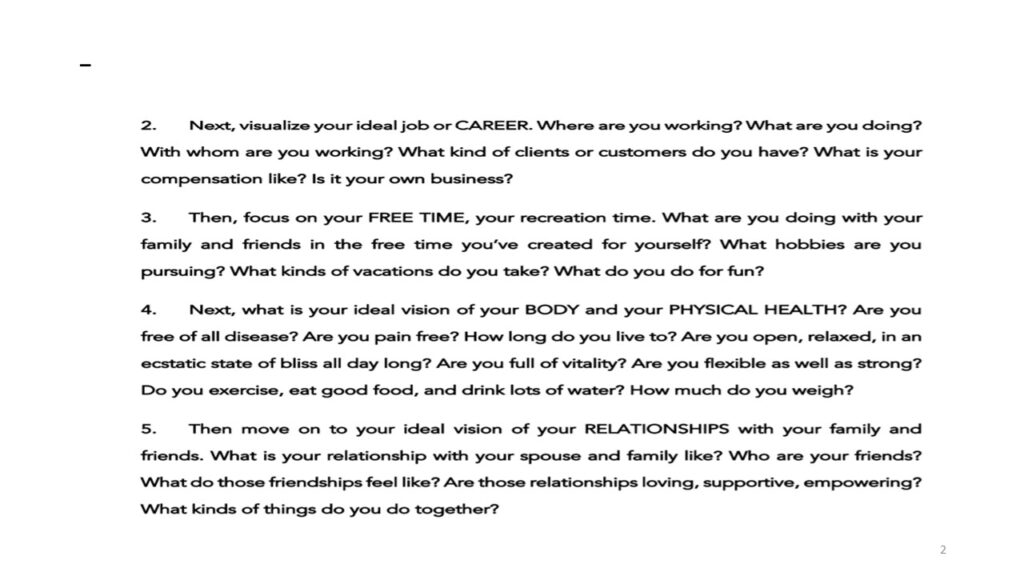
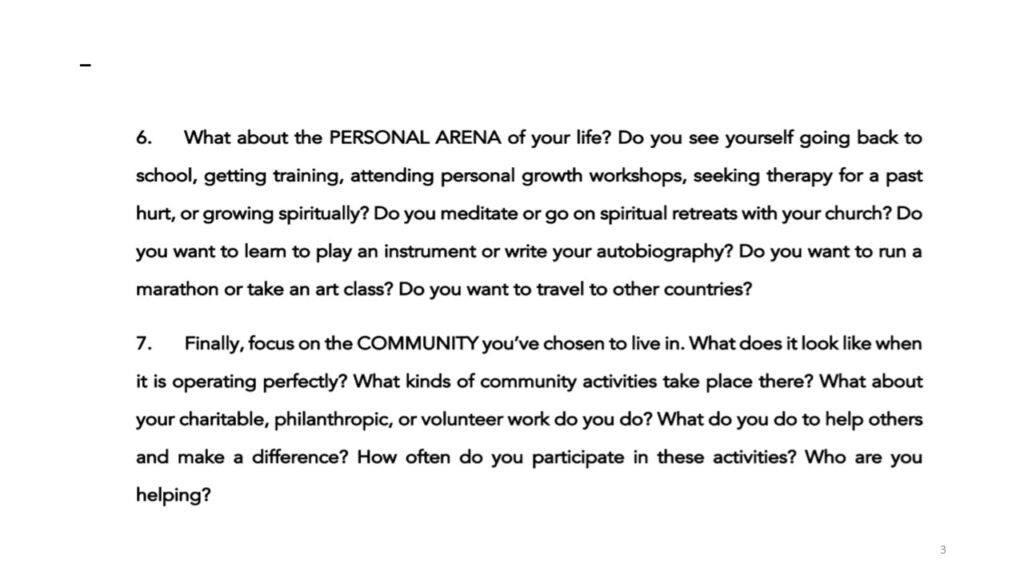
To create a balanced and successful life, your vision needs to include the following seven areas: work and career, finances, recreation and free time, health and fitness, relationships, personal goals, and contribution to the larger community. At this stage in the journey, it is not necessary to know exactly how you are going to get there. All that is important is that you figure out where “there” is. If you get clear on the what, the how will show up.
You will understand how the brain works to bring about what you want. You will then decide what you want in 7 keys areas of your life. “Success in life works the same way. All you have to do is decide where you want to go by clarifying your vision, lock in the destination through goal-setting, affirmations, and visualization, and then start moving in the right direction. Your inner GPS will keep unfolding your route as you continue to move forward.
In other words, once you clarify and stay focused on your vision, the exact steps will keep appearing along the way. Once you are clear about what you want and keep your mind constantly focused on it, the ‘how’ will keep showing up—sometimes just when you need it and not a moment earlier.
The Vision Exercise- What does Success Look Like?
The vision exercise is a very powerful tool to help you paint a picture of what a balanced and successful life looks like. Nothing is too big or too small. In this exercise you will gain a clearer picture of what success looks like to you. “You have to visualize clearly your future wants and desires. You do this by planning what you want to do, what you want to be, and what you want to have.
We’re going to look at seven categories of your life and decide what you want to create or experience in each of these categories. You are going to clarify what you truly want by making a list of things you want to do, things you want to have, and things you want to be before you die. This is a great way to get the ball rolling.
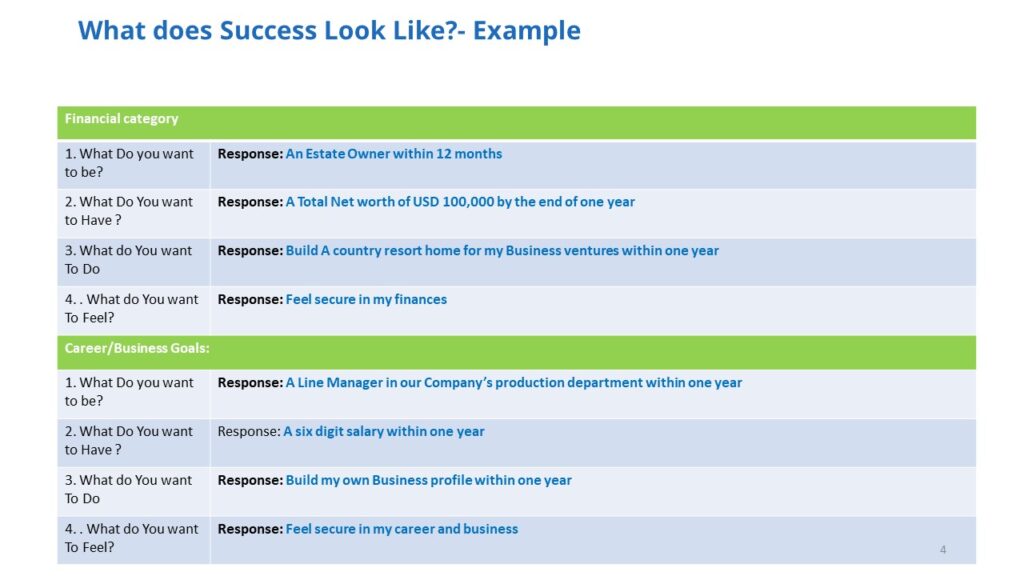
For Now, I want you to think about what you want in terms of the next twelve months as the time frame you are working with. If we were sitting here a year from now, what would you like to have happened in each of the seven categories of life? (categories are explained on the next page) I am going to suggest you come up with three things for each category.
If you want, you can close your eyes and ask your subconscious mind to give you images of what your ideal life would look like if you could have it exactly the way you want it. Then jot down those images for each of the Life categories:
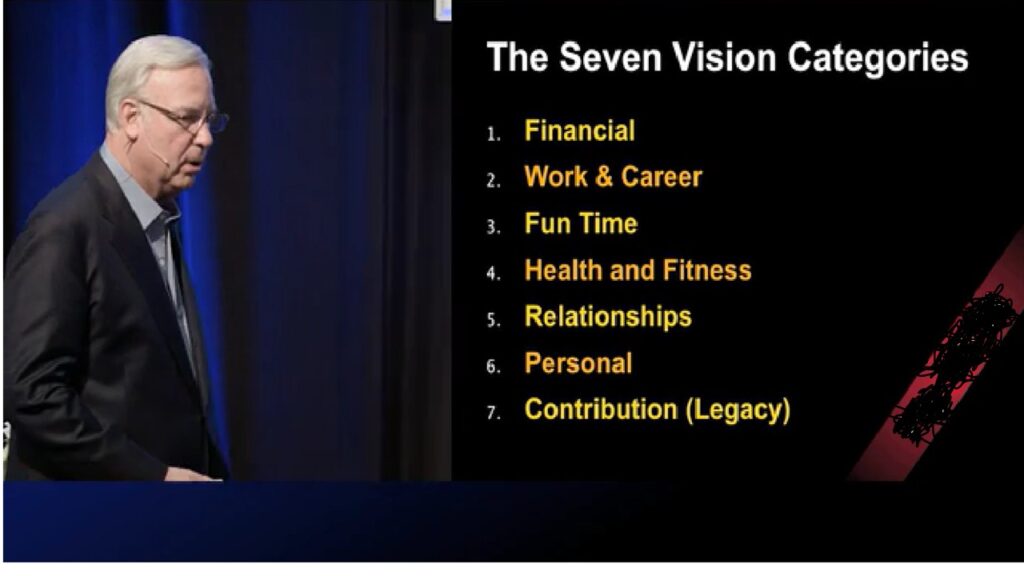
What does Success Look Like?-The Seven Categories Of Life-1
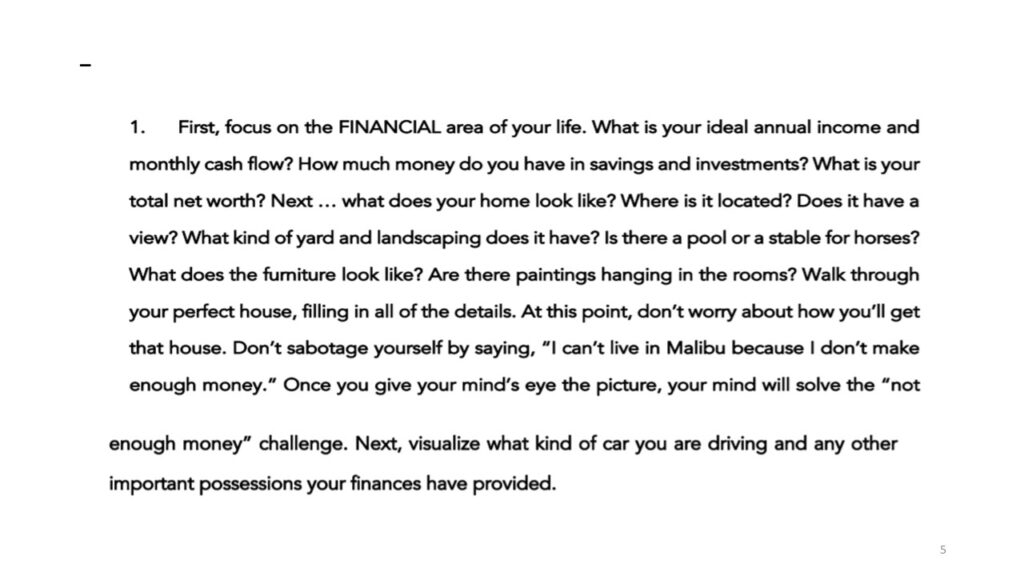
What does Success Look Like?- Example
For Now I want you to think about what you want in terms of the next twelve months as the time frame you are working with. If we were sitting here a year from now, what would you like to have happened in each of the seven categories of life? Come up with three things for each life category, one for each of the questions “What do you want to be, To Do, or To Have. –See example in the Table below:
What does Success Look Like?-Maximizing Impact Of Your Vision
To maintain motivation every day, review the vision you have written down. This will keep your conscious and subconscious minds focused on your vision, and—as you apply the other principles we’re learning—you will begin to manifest all the different aspects of your vision.
If you were doing this exercise at home, I would recommend—when you’ve finished writing down your vision—that you share your vision with a good friend whom you can trust to be positive and supportive. Don’t be afraid that your friend will think your vision is too outlandish, impossible to achieve, too idealistic, unrealistic, or materialistic. In truth most of our fellow humans, deep down in their hearts, want the very same things you want.
You’ll find that when you share your vision, some people will want to help you make it happen. Others will introduce you to friends and resources that can help you. You’ll also find that each time you share your vision, it becomes clearer and feels more real and attainable. And most importantly, every time you share your vision, you strengthen your own subconscious belief that you can achieve it.
Take those “wants” that you jotted down and turn them into specific goals. How do we write a specific goal? By designating how much, by when. Think about how you would quantify each goal. Start taking action on the “wants” that you wrote down. Do one thing per week in each of the seven areas that will get you closer to your goal.
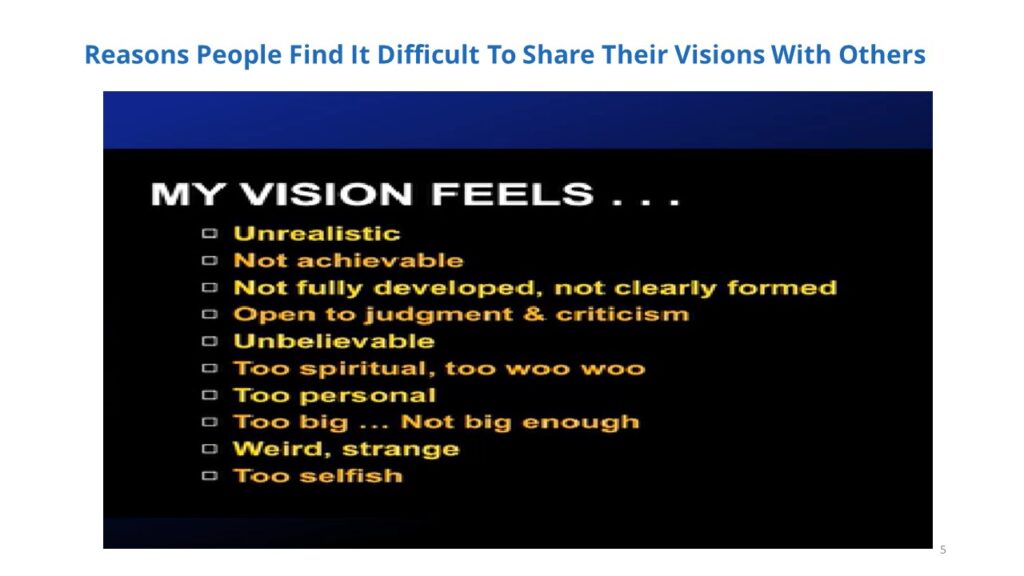
Reasons People Find It Difficult To Share Their Visions With Others
Not all people are comfortable revealing their vision to others. In one workshop on this subject the participants gave the following reasons why they were uncomfortable to reveal the visions they had come out with during the exercise
Share, Share, Share Your Vision
One of the reasons for a vision not manifesting is that you are not sharing it. People come up with all sorts of reasons not to share- It is unrealistic, not achievable, outlandish, weird, too selfish etc. They are used as reasons for holding back.
When you look at people who have made huge changes in the world, they have shared their visions –Martin Luther King, Mandela, Steve Jobs etc. When visions are shared they attract the attention of people who want to be part of them and they attract resources
Half of the goals that people achieve are achieved because they were shared. Somebody saw them and helped make them happen. So I encourage you to write down your goals and share them. Put them on your face book page, do a Blog for them, put them on your computer screen and let people know! Tell people what your vision is about because when you do that magical things begin to happen.
What does Success Look Like?-Visualization Makes Things Happen
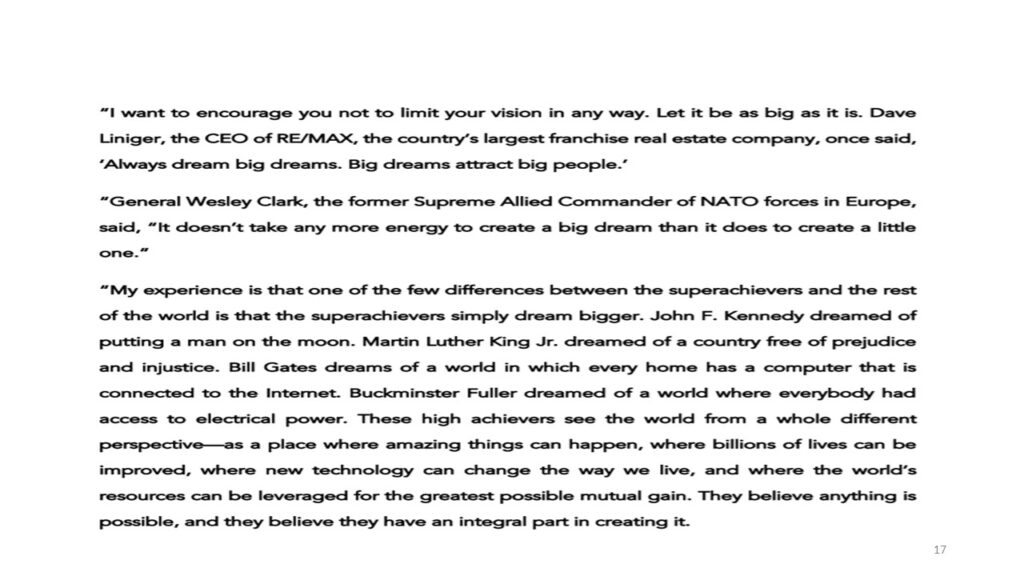
What does Success Look Like?-High Achievers Have Bigger Visions