

Introduction
The Success Principle: Keep your Agreements” is designed to teach, in an intentional way, the cost of not keeping agreements. It used to be that one’s word was one’s bond. Agreements were made and kept with a minimum of fanfare. People thought carefully about whether they could deliver on their promises before agreeing to anything. It was that important. Today, keeping one’s agreements seems to be a hit or miss affair.
This lesson illustrates the importance of keeping your agreements. When you do not keep your agreements, you pay both external and internal costs. These costs are high and can lead to loss of one’s self-esteem, self-confidence and self-respect.
Keep Your Agreements
Every agreement you make is ultimately with yourself. Your integrity and self-esteem are tied directly to your decision to maintain your agreements. By understanding the value of your integrity, you won’t make agreements that you don’t intend to keep, you will make fewer agreements and you will do whatever it takes to keep the ones you do make.
It is amazing how casually we give our word— and then how casually we break it. What is interesting is that most people know they are going to break at least one of the guidelines before agreeing to them; yet they agree to them anyway. Why? Most people want to avoid the discomfort of questioning the rules. They don’t want to be the focus of attention. They don’t want to risk confrontation of any kind. Others want to take the training without really following the rules, so they appear to agree, but they don’t really intend to follow through.
The real problem is not that people give and break their word so easily; it’s that they don’t realize the psychological cost of doing so. When you don’t keep your agreements, you pay both external and internal costs. You lose trust, respect, and credibility with others—your family, your friends, your colleagues, and your customers. And you create messes in your own life and in the lives of those who depend on you for getting things done—whether it’s showing up on time to leave for the movies, getting a report done on time, or cleaning the garage.
Every Agreement You Make with Others Is Also Made with Yourself
After a few weeks of not following through on your promise to take the kids to the park on the weekend, they begin not to trust you to keep your word. They realize they can’t count on you. You lose authority with them. Your relationship deteriorates.
More importantly, every agreement you make is ultimately with yourself. Even when you are making an agreement with someone else, your brain hears it and registers it as a commitment. You are making an agreement with yourself to do something, and when you don’t follow through, you learn to distrust yourself. The result is a loss of self-esteem, self-confidence, and self-respect. You lose faith in your ability to produce a result. You weaken your sense of integrity.
Let’s say that you tell your spouse you’re going to get up at 6:30 in the morning and do some exercise before going to work. But after 3 days of hitting the snooze alarm, your brain knows better than to trust you. Of course, you may think sleeping late is no big deal, but to your unconscious it is a very big deal. When you don’t do what you say you will, you create confusion and self-doubt. You undermine your sense of personal power. It’s not worth it
The High Cost of Not Keeping Your Agreements.
In seminars, participants have often been asked to agree to a list of ground rules that include things like: Be on time, sit in a different position everyday, attend all sessions and complete the seminar, No side talking, Turn cell phone off or put on vibrate, Follow all the facilitator’s instructions, Complete all the homework etc. In some cases this list may be presented to the participants who are then asked to sign against it. Something like: “I agree to keep all these guidelines and ground rules.”
Some facilitators have even asked participants to repeat each agreement out loud as a way for them to physically acknowledge that they are making an agreement. You will be surprised to learn that on the third day of the seminar a large number of participants will have broken their agreements. What becomes apparent is how casually we give our word— and then how casually we break it
Invariably reasons why people don’t keep their agreements will include convenience, comfort, approval, rebellion, control. When participants are asked the price of not keeping agreements they will mention things like loss of integrity, loss of respect, loss of power, confusion, and loss of self esteem. Perhaps some of you have felt lack of energy, tired, confused? Not all of it, but a lot of it stems from not keeping agreements with ourselves. You stop believing yourself, and lose your integrity.
A sense of power and certainty comes with keeping agreements with your self. Certainty is clarity; If I am absolutely clear about something, I know it will happen. Having integrity with your word is the same thing. We want to get to a place where our words matter, they have power, and where we can trust ourselves to keep our agreements. In the outer world, the cost when we don’t keep our agreements is loss of trust. If you are not a model for what you are expecting, you are not going to get that back from your audience.
Your Integrity and Self-Esteem Are Worth More Than a Million Dollars
When you realize how important your integrity and self-esteem really are, you will stop making casual agreements just to get someone off your back. You won’t sell your self-esteem for a little bit of momentary approval. You won’t make agreements you don’t intend to keep. You will make fewer agreements, and you will do whatever it takes to keep them
Once you realize how important keeping your word is, you realize you have the ability to do it. It’s simply a matter of realizing what you are giving up. The personal power that you get from keeping your agreements is worth a whole lot more than a million dollars.
If you want more self-esteem, self- confidence, self-respect, personal power, mental clarity, and energy, then you’ll make keeping your word more important.
If you want to have the respect and trust of others, which is critical to accomplishing anything big and important in life (including making a million dollars), then you will take keeping your agreements more seriously.
Tips for Keeping your agreements.
.
Make only agreements that you intend to keep. Take a few seconds before making an agreement to see if it is really what you want to do. Check in with yourself. How does your body feel about it? Don’t make an agreement just because you are looking for someone’s approval. If you do, you’ll find yourself breaking these commitments
One of the big reasons we don’t keep our agreements is that with the daily pressure of all of our activities, we forget many of the agreements that we have made. Write them down, and then review your list every day
Communicate any broken agreement at the first appropriate time. As soon as you know you are going to have a broken agreement—your car won’t start, you are caught in traffic, your child is sick, your babysitter can’t make it, your computer crashes—notify the other person as soon as possible, and then renegotiate the agreement
Communicating broken agreements demonstrates respect for others’ time and their needs. It also gives them time to reschedule, re-plan, make other arrangements, and limit any potential damage. If the first appropriate time is after the fact, still let them know that you have a broken agreement, clean up any consequences, and decide whether to recommit to the agreement.
Clarify that you have agreements with other people. Clarify the agreement so you both have the same understanding.
Learn to say no more often. Give yourself time to think it over before making any new agreements
Everything that you want to accomplish requires relationships—with your friends, family, staff, vendors, coaches, bosses, board of directors, clients, customers, partners, associates, students, teachers, audience, fans, and others. For those relationships to work, you need to set up the rules of engagement or “the rules of the game.
How are we going to play together? What are the ground rules and guidelines for the relationship going to be? If you and all the people you interacted with were to agree to and keep a set of rules, your level of success would soar.
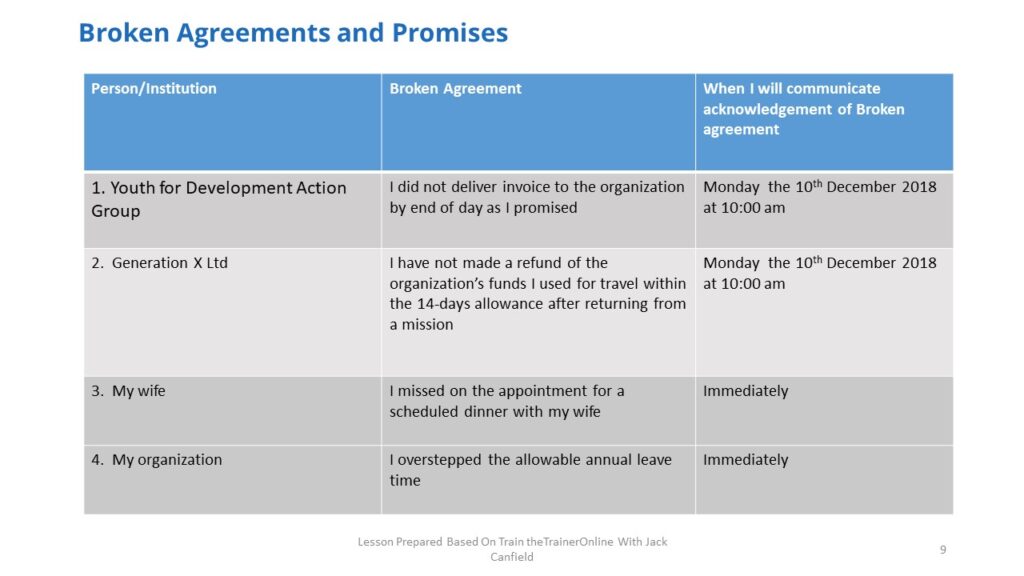
Broken Agreements and Promises
List people and institutions with whom you have broken agreements or lapses of integrity. Decide when you will communicate your acknowledgement of this broken agreement to them, or communicate that you no longer wish to keep this agreement, or negotiate a new time by which you will complete it. If it is a lapse in integrity, communicate the event plus any way in which you would like to balance the situation. Check it off as done when you have completed the action or the communication. Here are a few of examples of broken agreements and when I will communicate acknowledgement of the broken agreement
Conclusion
Let us have less broken agreements, more kept agreements and when we do break them let us do the honorable responsible thing-acknowledge it, renegotiate the agreements and get back in the balance so that we save the energy we need to drive us through to our goals and success
“Your life works to the degree you keep your agreements.” – Werner Erhardt, Founder of the est Training and Landmark Forum
“Never promise more than you can perform.” – PubLilius Syrus
If you want to have the respect and trust of others, which is critical to accomplishing anything big and important in life, then you will take keeping your agreements more seriously.